WordPress still powers a large portion of the internet. It remains a capable publishing platform for blogs, marketing pages, and standard websites.
However, enterprise digital ecosystems have evolved. Modern brands no longer publish content to a single website. They distribute it across multiple platforms, regions, applications, and systems. As this complexity increases, traditional CMS architectures begin to show limitations.
This is why many enterprise organizations are shifting toward Top 30 Headless CMS to Watch in 2026.
1. The CMS Is No Longer Just a Website Tool
Traditional WordPress was built for websites, with the frontend and CMS tightly connected.
Today, enterprise content must extend beyond a single site. Modern headless platforms such as Contentful, Strapi, Sanity, Storyblok, Contentstack, Hygraph, Prismic, and Directus are built to distribute structured content across any digital touchpoint.
The website is just one channel. Modern CMS architecture must function as omnichannel infrastructure — not just a publishing system.
2. Content as Structured Infrastructure
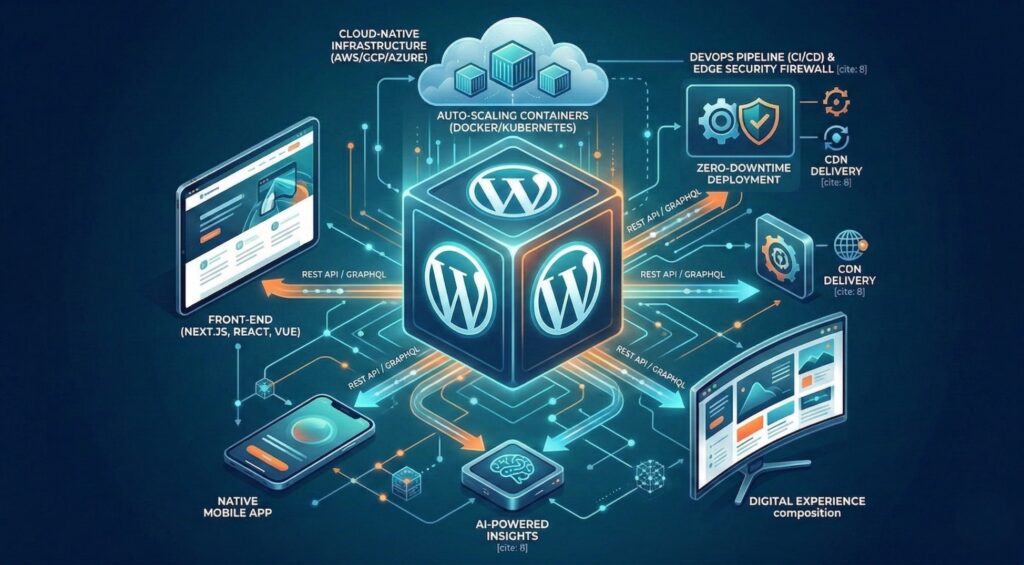
A headless CMS separates content from the presentation layer, turning it into structured, reusable infrastructure delivered via APIs.
Leading platforms such as Contentful, Strapi, Sanity, Storyblok, Contentstack, Hygraph, Prismic, Directus, and headless WordPress enable organizations to centralize content and distribute it across any digital channel.
Because content exists independently from design, teams can redesign frontends, launch new digital products, or expand into new markets without rebuilding the core system.
Structured content transforms the CMS from a publishing tool into enterprise digital infrastructure.
3. Omnichannel Content Distribution
Enterprise brands require the same content to appear consistently across websites, mobile apps, marketplaces, and internal systems.
In traditional page-based CMS environments, this often results in duplication, fragmented workflows, and complex custom builds.
Modern headless CMS platforms solve this through modular content models and API-first architecture. Solutions such as Contentful, Strapi, Sanity, Storyblok, Prismic, Contentstack, headless WordPress, Ghost, Directus, DatoCMS, and Hygraph enable teams to update content once and distribute it everywhere.
This ensures consistency, scalability, and governance across the entire digital ecosystem.
4. Governance and Workflow Control
Enterprise publishing involves legal review, compliance validation, brand governance, and regional collaboration. As complexity increases, managing roles and workflows inside heavily customized WordPress environments can become operationally fragile.
Modern headless platforms such as Contentstack, Contentful, Sanity, Storyblok, and Hygraph provide structured approval workflows, granular permissions, audit logs, content versioning, scheduled releases, and environment-based publishing.
These capabilities enable enterprise-grade governance, scalability, and compliance — without depending on layered plugins or custom workflow patches.
5. Security Considerations
Maintaining enterprise environments built on WordPress often requires continuous plugin updates, theme patches, hosting optimization, and ongoing security monitoring. Heavy reliance on third-party extensions can increase risk exposure.
Modern headless platforms such as Contentful, Contentstack, Hygraph, Sanity, and Strapi reduce the public attack surface by separating the content backend from the frontend layer.
The CMS can remain access-restricted while the frontend operates independently — often as a static, server-rendered, or edge-delivered application.
No architecture eliminates risk entirely. However, structural separation significantly simplifies enterprise-level security, compliance, and risk management.
6. Performance and Scalability
Performance remains critical for user experience, SEO, and revenue. While WordPress can be optimized, enterprise-scale implementations often require advanced caching layers, CDN configuration, database tuning, and continuous monitoring.
Headless platforms such as DatoCMS, Directus, Prismic, Ghost (in headless mode), and Builder.io are often paired with modern frontend architectures optimized for speed and horizontal scalability.
Static site generation, edge delivery, API-based rendering, and granular resource control allow organizations to meet strict performance benchmarks across global regions.
By separating content management from frontend delivery, enterprises gain architectural flexibility — enabling faster deployment cycles, improved resilience, and scalable digital expansion.
7. Developer Experience and Modern Architecture
Enterprise development teams increasingly rely on component-based design systems, CI/CD pipelines, automated testing, and structured frontend frameworks. Integrating these workflows into traditional WordPress themes often requires significant customization.
Headless platforms such as Strapi, Sanity, Hygraph, Directus, and Storyblok align more naturally with modern development practices.
Frontends are built as independent applications, content is accessed via APIs, and deployment pipelines remain predictable, version-controlled, and environment-aware — enabling cleaner architecture and faster engineering velocity.
8. Total Cost of Ownership
While WordPress licensing costs are low, enterprise implementations often require significant investment in custom development, hosting infrastructure, security hardening, performance optimization, and continuous maintenance.
Headless platforms such as Contentstack, Contentful, DatoCMS, and Prismic may involve higher upfront licensing or subscription costs. However, they often reduce long-term operational complexity for organizations managing multiple brands, regions, and digital products.
For enterprises operating at scale, architectural efficiency, governance control, and reduced technical debt frequently outweigh initial licensing savings.
Conclusion
Enterprise brands are not moving away from WordPress because it is ineffective. They are adopting headless CMS platforms such as Contentful, Contentstack, Sanity, and Strapi because content now extends far beyond a single website.
As digital ecosystems expand across regions, devices, and platforms, enterprises require structured, reusable, and scalable content architectures. Headless CMS solutions provide a framework that aligns more effectively with modern omnichannel strategies, governance standards, performance demands, and development workflows.
In 2026, the shift is less about following trends — and more about making long-term architectural decisions that support sustainable enterprise growth.
FAQs (Frequently Asked Questions)
1, Why are big brands ditching WordPress in 2026?
It’s no longer just about websites. Brands today need to push content to apps, screens, and AI tools simultaneously. WordPress was built for a single site, making it too rigid for today’s “publish everywhere” world.
2, What’s the main problem with traditional WordPress?
It locks your content and your website design together. If you want that same content on a mobile app or a partner portal, you usually have to copy-paste it or build messy workarounds that break at scale.
3, What exactly is a Headless CMS?
Think of it as a content bank with no fixed “face.” It stores your data centrally and sends it via APIs to any device phones, kiosks, or sites. You can redesign your front end anytime without touching your actual content.
4, How does this help with omnichannel marketing?
It treats content as modular blocks rather than pages. You can create one product description and automatically pull the “short version” for an app and the “full version” for the web, keeping everything consistent and governed.
5, Is it actually more secure and faster?
Yes. By removing the constant need for plugins (1 source of WordPress hacks), you shrink your attack surface. Plus, using modern tech like edge rendering makes your site much faster, which is a massive win for SEO and user experience.