
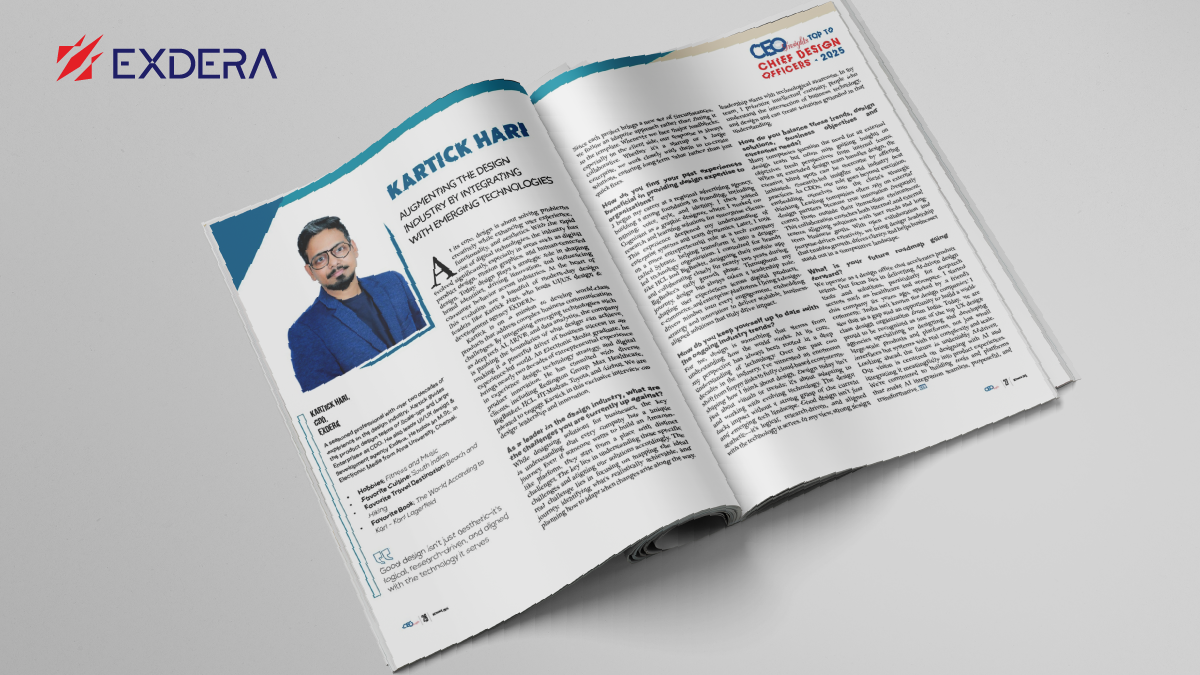
In the digital age, design has shed its skin as a purely aesthetic discipline. It is no longer just about making things look good; it is a strategic powerhouse driving innovation, shaping brand identities, and influencing consumer behavior. At its core, modern design is about creatively solving complex business problems while enhancing user experience.
But what happens when you fuse this strategic design mindset with the transformative potential of emerging technologies like Artificial Intelligence?
You get a new paradigm of business innovation—one that forward-thinking companies are leveraging to gain a significant competitive edge. Leading this charge are design visionaries like Kartick Hari, Founder and CEO of the UI/UX design and development agency EXDERA. With nearly two decades of experience, Kartick is on a mission to build world-class products that solve adaptive business communication challenges.
In the deep dive done by CEO Insights India, we share the insights from Kartick’s journey and uncover why a strategically integrated design approach is no longer a luxury, but a necessity for B2B success.
The Modern Design Challenge: It’s Not About the Template, It’s About the Journey
One of the most pressing questions for business leaders is: what are the real challenges in designing solutions that work?
According to Kartick, the key lies in a fundamental understanding that every company has a unique challenge. Even when building a platform similar to an existing market leader, the starting point, constraints, and goals are distinct.
“The real challenge lies in focusing on mapping the ideal journey, identifying what is realistically achievable, and planning how to adapt when changes arise along the way,” says Hari.
This reality demands an adaptive approach, not a one-size-fits-all template. For EXDERA, this means when roadblocks appear—especially on the client side—the response is inherently collaborative. Whether working with a startup or a large enterprise, the focus is on executing solutions that provide long-term value, not just quick fixes. This philosophy ensures that the design is robust, scalable, and built to evolve with the business.
Hari’s foundation was laid in a regional advertising agency, building a solid core in branding, style, and identity. This is where he learned that design is the face of a business’s soul. Moving to Cognizant as a graphic designer, he immersed himself in enterprise systems, understanding the intricacies of team dynamics and large-scale digital collaboration.
His entrepreneurial leap came at a tech company called Sylvain, where he helped steer its transformation into a complex tech-led organization. This experience, coupled with consulting for major brands like BigBanker and IICL, cemented his belief that design is, first and foremost, a leadership role.
This rich background—spanning branding, enterprise ethics, tech transformation, and consulting—provides EXDERA with a unique, 360-degree perspective. It’s not just about designing an interface; it’s about building systems that drive commerce, intelligence, and business growth.
Staying Ahead: Why Technological Awareness is the Bedrock of Design Leadership
In a field driven by trends, how does a top-tier design leader stay relevant? The answer isn’t found in chasing the latest visual fad.
For Kartick, successful design stems from a deep understanding of how the world works, powered by technology. Having witnessed the shift from “floppy solutions to fully-optimized ecosystems,” his perspective is rooted in technological fluency.
“Design today isn’t just about visuals or trends; it’s about adapting to ideas through skill evolving technology. The design lacks impact without a strong grasp of the current and emerging tech landscape.”
This is a critical insight for any business looking for a design partner. Good design is logical, research-driven, and aligned with the technology it serves. A beautiful app with a clunky, inefficient backend is a failure. A stunning website that doesn’t integrate with your CRM is a missed opportunity. Therefore, strong design leadership starts with technological awareness.
The Strategic Advantage of an External Design Partner
Many companies grapple with a fundamental question: Do we build an in-house design team or partner with an external agency?
While internal teams have their place, they can sometimes lack the unbiased perspective and broad industry exposure needed for breakthrough innovation. This is where an external design partner like EXDERA provides immense value.
“When an extended design team handles design, the entire third spots can be overcome by offering unbiased, personalized insights and industry best practices.”
As Kartick explains, the role of a Chief Design Officer (CDO) or an external partner goes beyond mere execution. It involves embedding into the client’s business dialogue. Leading companies often rely on external design partners because true innovation frequently comes from outside their immediate ecosystem.
This collaboration creates a powerful synergy. The internal team provides deep institutional knowledge, while the external partner brings fresh perspectives, cross-industry best practices, and a focused drive for innovation. The result is a solution perfectly aligned with user needs and long-term strategic goals.
The Future Roadmap: Designing with AI for a Transformative Impact
Looking forward, the vision for EXDERA is clear and ambitious. They operate as a design office that accelerates product teams, delivering diverse tools and solutions, particularly for deep tech and responsive AI solutions.
The company’s very origin was sparked by a challenge. “India isn’t known for design companies,” a friend remarked. Kartick saw this not as a limitation, but as an opportunity to build a world-class design organization from the ground up.
Today, EXDERA is recognized as one of the top agencies specializing in designing and developing large-scale products and platforms; not just small interfaces, but complex systems for web, mobile, and enterprise solutions.
And the future is unequivocally centered on AI.
“Our vision is centered on designing with AI and integration, investigating the product experiences. We’re committed to building wide and platforms that make AI integration seamless, purposeful, and transformative.”
This forward-looking stance positions EXDERA at the forefront of the next wave of digital transformation. For B2B clients, this means partnering with a team that is not just using AI as a buzzword, but is actively building the frameworks to make it an integral, value-driven part of business products and platforms.
As Kartick Hari succinctly puts it: “Good design isn’t just aesthetic—it’s logical, research-driven, and aligned with the technology it serves.”
In the competitive B2B landscape, this philosophy is what separates market leaders from the rest. It’s the difference between a product that simply functions and one that revolutionizes an industry.
The integration of strategic design with emerging technologies like AI is creating unprecedented opportunities for businesses to solve old problems in new ways, connect with users on a deeper level, and build scalable, future-proof systems.
For leaders looking to navigate this complex terrain, the path is clear: embrace a design partnership that brings technological awareness, strategic leadership, and a collaborative spirit to the table. The goal is not just to create a product, but to design a vehicle for sustained growth and market leadership.