
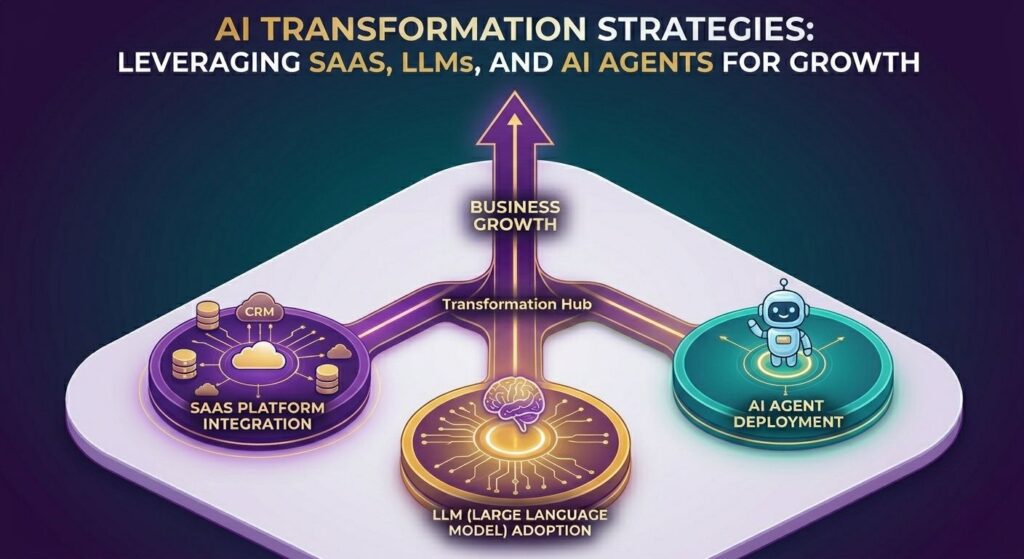
Exdera Global is an AI transformation and enterprise Vision AI company that helps organisations move beyond isolated experiments and embed artificial intelligence into the core of how their business operates. Not as a side project. Not as a proof-of-concept that never ships. As a production-ready, scalable capability that delivers measurable outcomes.
Their work spans large enterprises modernising legacy systems, SaaS companies embedding AI-driven features into their products, and organisations deploying AI agents, copilots, and custom LLMs — including ChatGPT Enterprise, Gemini AI, and Claude AI — across departments and business units.
What makes their approach different is the emphasis on integration over isolation. Every solution built by the Exdera Global AI Transformation team is designed to connect seamlessly with existing platforms — using API-first, modular architectures deployable on AWS, Google Cloud, or hybrid environments. The AI doesn’t sit beside your business. It runs inside it.
Their 4-step delivery model — Discover, Design, Deploy, Scale — ensures that every engagement starts with identifying the highest-impact AI use cases, not with selling a predetermined stack. That’s a meaningful difference in an industry full of solutions looking for problems.
From Hype to Reality: What’s Actually Changed
Remember when ‘digital transformation’ was the phrase on every consultant’s lips? Companies spent millions migrating to cloud platforms and automating paperwork. Some of it worked. A lot of it didn’t. The reason? The intelligence layer was still entirely human.
That’s what’s changed. For the first time in computing history, we have systems that can reason, write, interpret images, and make judgment calls — not just execute rules. That’s not hyperbole. That’s the practical reality of working with today’s LLMs, SLMs, and Vision AI systems.
We’ve crossed a threshold. Earlier waves of automation replaced muscle. This wave replaces cognitive grunt work — drafting, classifying, summarising, deciding. And unlike previous technology shifts, the capability gap between early adopters and late movers is compounding every quarter.
| AI transformation isn’t about replacing people. It’s about finally giving your best people the leverage they deserve — and eliminating the work that was grinding them down. |
Visit exderaglobal.com/ai-transformation and you’ll see this philosophy in action: AI as a strategic capability-builder, not a tech project.
The Three Pillars of Practical AI Transformation
1. SaaS — Your Foundation, Not Your Strategy
Modern SaaS platforms are remarkable. Cloud-native, API-first, deeply integrated — they’ve turned what used to take months to build into drag-and-drop workflows. But here’s where organizations get stuck: they treat SaaS adoption as the transformation itself.
It isn’t. SaaS is your foundation. The transformation happens when you instrument that foundation to feed intelligent systems — when your CRM talks to your LLM, when your ERP surfaces anomalies to an AI agent before a human ever notices them.
| Real Talk Companies that invest in data governance and clean API pipelines alongside their SaaS modernization see 3-5x faster AI ROI. The ‘boring’ infrastructure work is actually the most strategic work you can do right now. |
2. LLMs and SLMs — Right Model, Right Job
Not every AI problem needs a frontier Large Language Model. In fact, deploying a massive general-purpose model on a task that could be handled by a fine-tuned Small Language Model is a bit like using a power plant to charge your phone.
Here’s a simple way to think about it:
| Large Language Models (LLMs) | Small Language Models (SLMs) |
| Complex, open-ended reasoning | Specialized domain classification |
| Writing & content generation | Low-latency edge inference |
| Code generation & review | On-premise / regulated environments |
| Multi-domain knowledge synthesis | High-volume cost-efficient automation |
A smart transformation strategy doesn’t pick one — it builds an intelligent routing layer that matches models to tasks dynamically. This is where organizations start seeing real cost savings alongside performance gains.
3. Vision AI — The Capability Most Teams Are Sleeping On
While everyone’s talking about chatbots and text generation, Vision AI is quietly delivering some of the highest returns in industrial AI transformation. We’re talking about systems that inspect production lines at superhuman speed, read documents without human data entry, and monitor retail shelves in real time.
The exciting frontier right now is multi-modal AI — systems that simultaneously process images, video, text, and structured data. Think of a construction site agent that photographs a work area, checks it against a safety checklist, flags violations, and generates a corrective action report. No forms. No clipboard. Just results.
| Vision AI isn’t science fiction anymore. A mid-sized manufacturer using visual inspection AI can reduce defect escape rates by 60-80% within months of deployment — with the data trail to prove it. |
AI Agents: Where Transformation Becomes Real
Here’s what gets me genuinely excited: AI agents. Not because they’re new and shiny, but because they change the fundamental question organizations ask themselves.
Instead of ‘How do we automate this task?’ the question becomes ‘What decisions should humans still own, and what can we fully delegate to an intelligent system?’ That’s a strategy conversation, not a tech conversation.
AI agents are autonomous systems that perceive their environment, reason about goals, call APIs and tools, and execute multi-step workflows. They handle ambiguity. They escalate intelligently. They don’t break when edge cases appear.
| Real-World Example A procurement agent doesn’t just send purchase orders — it sources vendors, evaluates quotes against historical data, flags unusual pricing, drafts contract language, and only escalates to a human when it detects a risk threshold. That’s hours of work reduced to minutes, every single day. |
The teams at Exdera have been building and deploying agent frameworks across procurement, customer support, financial monitoring, and compliance functions — each mapped to measurable business outcomes, not technology milestones.
Essential Tools for Your AI Transformation Stack
Knowing the landscape helps. Here are the categories and key tools that enterprise teams are actually using in 2026:
LLM & Foundation Model Platforms
| OpenAI GPT-4o LLM | Industry-leading general reasoning, multimodal capabilities, and a rich API ecosystem. Use case: Customer-facing assistants, content generation, code review |
| Anthropic Claude LLM | Strong long-context reasoning, safety-focused architecture, excellent for document analysis. Use case: Contract analysis, compliance review, knowledge management |
| Mistral / Phi-3 SLM | Lightweight, fast, and deployable on-premise — ideal for regulated industries or edge use cases. Use case: Healthcare NLP, manufacturing inference, financial scoring |
AI Agent Frameworks
| LangGraph Agent Orchestration | Stateful, graph-based agent workflows with fine-grained control over multi-step reasoning. Use case: Complex multi-tool agent pipelines, RAG workflows |
| AutoGen (Microsoft) Multi-Agent | Framework for building networks of collaborating AI agents that divide and conquer complex tasks. Use case: Research agents, code generation pipelines, business process automation |
| CrewAI Multi-Agent | Role-based agent teams that collaborate with defined responsibilities and memory. Use case: Procurement, research, content production teams |
Vision AI & Multimodal Tools
| Google Vision AI Vision AI | Enterprise-grade image labeling, OCR, object detection, and document processing at scale. Use case: Document digitization, retail shelf analytics, quality inspection |
| Azure AI Vision Vision AI | Microsoft’s cloud vision suite with strong integration into enterprise data pipelines. Use case: Industrial inspection, identity verification, accessibility tools |
| Roboflow Computer Vision | End-to-end platform for building, training, and deploying custom computer vision models. Use case: Custom defect detection, inventory counting, safety compliance |
Data & Embedding Infrastructure
| Pinecone Vector DB | Managed vector database for semantic search and Retrieval-Augmented Generation (RAG). Use case: Knowledge base search, enterprise chatbots, personalization |
| Weaviate Vector DB | Open-source vector search engine with hybrid search and multi-tenancy support. Use case: Enterprise RAG systems, multi-client SaaS platforms |
The Part Nobody Talks About: The Human Side
You can have the best AI stack in the world and still fail if you ignore the people piece. And I’ve seen it happen — smart organizations with great technology that couldn’t get their teams to trust it, adopt it, or adapt to it.
AI transformation is change management with a machine at the center. That means clear communication about what’s changing and why. It means celebrating early wins loudly. It means involving the people closest to the work in designing the systems that will change their work.
The teams that succeed don’t treat AI as something happening to their employees — they treat it as something their employees are building together.
| The best AI transformation projects I’ve seen had one thing in common: frontline staff who felt like co-creators, not casualties. That’s not a soft observation — it’s the hard-won lesson of every organization that’s scaled AI successfully. |
Your Transformation Roadmap: Where to Start
Feeling ready to move? Here’s a practical sequencing that consistently delivers:
| Phase | Focus | Key Outcome |
| 1 | Data Infrastructure | Clean, accessible, API-ready data pipelines |
| 2 | Model Selection | Right LLM/SLM/Vision stack for your use cases |
| 3 | Pilot Agents | Deploy agents on one high-value, contained workflow |
| 4 | Measure & Scale | Prove ROI, expand, and govern with feedback loops |
Frequently Asked Questions
We get asked similar questions a lot. Here are honest answers — no jargon, no spin.
| Q1. What’s the difference between AI transformation and just buying AI software? |
| Great question — and a really important one. Buying AI software is a purchase. AI transformation is a capability shift. When you buy software, you get a tool. When you transform, you redesign how decisions get made, how workflows run, and how people work — with AI embedded at every step. Most organisations that “buy AI” and see little return are doing the former while hoping for the latter. |
| Q2. Do we need to replace all our existing systems to start? |
| Absolutely not. The most successful transformations we see at Exdera Global build on top of existing SaaS stacks using APIs, not around them. Start with what you have, identify where intelligence can be layered in, and modernise incrementally. A rip-and-replace mentality is one of the biggest reasons AI projects stall before they deliver value. |
| Q3. How do we choose between an LLM and an SLM for our use case? |
| Ask three questions: How much latency can we tolerate? How sensitive is the data? How specialised is the task? If you need real-time inference on proprietary data in a regulated environment — an SLM deployed on-premise is almost always the right call. If you need nuanced reasoning across broad knowledge, a frontier LLM makes sense. Most mature organisations use both, routed intelligently. |
| Q4. Is Vision AI only relevant for manufacturing? |
| Not at all — though manufacturing is where the ROI is most immediate and measurable. Vision AI is delivering value in retail (planogram compliance, footfall analytics), financial services (intelligent document processing), healthcare (diagnostic image analysis), logistics (automated receiving and damage assessment), and construction (safety compliance monitoring). If your business touches physical reality in any form, Vision AI probably has a use case for you. |
| Q5. How long does an AI transformation typically take? |
| The honest answer: a meaningful first result in 8–16 weeks; enterprise-wide impact in 12–24 months. The timeline depends far more on data readiness and change management than on the technology itself. Organisations with clean data pipelines and bought-in leadership consistently move faster. Those without either tend to extend pilots indefinitely without scaling. |
| Q6. What if our team is worried about AI replacing their jobs? |
| This is the most human question in the room, and it deserves a human answer. AI will change jobs — it won’t eliminate most of them. The work that disappears is typically the work people find most tedious: data entry, repetitive classification, formulaic reporting. The work that expands is judgment, creativity, relationship-building, and exception-handling. The best transformation programmes bring staff into the design process early so they shape what changes, rather than having change happen to them. |
| Q7. How do we measure ROI on an AI transformation initiative? |
| Tie every AI initiative to a specific business metric before you start. Cycle time. Error rate. Conversion rate. Customer satisfaction score. Cost per transaction. Vague goals produce vague results. At Exdera, we insist on defining the measurement framework in week one — not after deployment. That way, the AI system is designed to move a number, not just demonstrate capability. |
| Q8. Where should a mid-sized business start if budget is limited? |
| Pick one painful, high-frequency, well-documented process and fix it completely. Don’t spread budget across five pilots — go deep on one. The win builds confidence, the data builds your case for the next initiative, and the learning builds your team’s capability. A single well-executed agent that saves 20 hours per week is worth more strategically than five half-built proof-of-concepts gathering dust. |
Final Thought: Move with Urgency, Build with Patience
The window for first-mover advantage in AI is real — but it’s measured in strategy, not sprints. The organizations compounding advantage right now aren’t the ones who deployed the most pilots. They’re the ones who chose fewer, harder, more consequential problems and solved them completely.
Exdera Global works with enterprises across industries — from manufacturing and logistics to healthcare and SaaS — to design and deploy AI systems that are secure, compliant, and production-ready from day one. Their services cover AI Transformation, Vision AI Solutions, AI Platform Development, Digital Twin, Cloud Infrastructure, and Technology Consulting — everything you need to move from strategy to scale without switching partners.
Whether you’re ready to integrate ChatGPT, Gemini, or Claude AI into your workflows, deploy custom LLMs on private infrastructure, or build AI agents that automate your most complex processes — Exdera Global can take you from AI ambition to AI in production. Start with a free consultation — no commitment, just clarity on where to go next.


